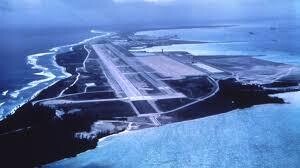
This difference in criteria does not reduce the concern: on the contrary, it shows that the attack on Diego Garcia opened a grey area regarding the true operational scope of the Iranian arsenal and how much of that power was known, underestimated, or deliberately concealed. The sensitive point is that the threat is no longer discussed only in abstract terms. Diego Garcia is one of the most valuable military enclaves of the Anglo-American device in the Indian Ocean, capable of sustaining bombers, nuclear submarines, and operations towards the Middle East, East Africa, and southern Asia. However, this interpretation is not accepted unreservedly by all Western governments. Because if Iran managed to project fire as far as Diego Garcia, the discussion ceased to be regional and directly touched upon the security of Europe's flank. The episode did not produce impacts on the base—one of the projectiles failed in flight and the other was countered by Western defenses—but its political and military value was enormous because it showed a range superior to what Iran had publicly recognized for years. European concern grew even more when the Chief of the Israeli General Staff, Eyal Zamir, stated that the launch exhibited a capability of around 4,000 kilometers, sufficient—according to the Israeli assessment—to put capitals like Berlin, Paris, and Rome at risk. London, March 22, 2026 - Total News Agency - TNA - The Iranian attempt to strike the joint United States and United Kingdom base on Diego Garcia, in the middle of the Indian Ocean, sounded an alarm throughout Europe and opened a strategic discussion that until a few days ago seemed reserved for military laboratories: if Tehran was able to project two ballistic missiles towards a target located about 3,800 or 4,000 kilometers from its territory, then a relevant part of the European continent was, at least theoretically, within its new radius of threat. For this reason, beyond London today denying having evidence of a direct and immediate threat to the continent, the alarms have already sounded in Europe. The British government itself authorized Washington on Friday to use Diego Garcia and RAF Fairford for defensive operations against Iranian installations that threaten navigation in the Strait of Hormuz, although it expressly left out RAF Akrotiri, in Cyprus, to avoid an additional escalation on the Mediterranean flank. Tehran's logic seems to be that of a 'horizontal escalation': not to concentrate the entire conflict on Israel or the Gulf, but to expand it to new scenarios to multiply the political and military cost for the Western coalition. The sequence leaves an uncomfortable conclusion for Europe: the more Western bases get involved in the war, the more the map of targets that Iran considers legitimate expands. In that context, the attack on Diego Garcia is not read as a simple tactical retaliation, but as a strategic warning. This Sunday, British minister Steve Reed affirmed that London has no evidence that Iran is targeting Europe with ballistic missiles or that it has a confirmed capability to do so. But that technical doubt does not nullify the central fact: the launch existed, the distance was extraordinary, and the message arrived. Under that logic, Europe ceases to be merely a diplomatic rear and becomes a space of direct defensive concern. There is still no conclusive public confirmation on the exact missile model Iran used, or whether that range was achieved with an already operational vector or with a lightweight or adapted version of pre-existing systems. Iranian Foreign Minister Abbas Araghchi had accused Prime Minister Keir Starmer of putting British lives at risk by allowing the use of UK bases against Iran, and the missile launch came precisely after that warning.